
A Story in Storeys
Word by Word, Brick by Brick
Crow News:
Let’s get the admin stuff out of the way. If you sent us work for consideration in Issue 63 (publication date: April 15, 2026). and assuming it met the submission rules, then we will notify you after March 15. The assumption is a necessary one, alas. Besides spam, we also get more than a few invalid submissions. For example, one poem submissions, when we asked for three to five; novellas when we asked for stories between 2K-5K words; unattractive photographs in lieu of appealing writing; and that old vexer, incorrect email addresses. That said, if you haven’t heard from us by April 01, do contact us at help@bombaylitmag.com.
The phrase “submission rules” joins in unhappy matrimony two equally unpleasant words: “submission” and “rules”. Though one is grateful—as was said about the marriage of Mr and Mrs Carlyle— that this limited the damage to two when it could have involved four, the fact is that neither term suits the artist’s imagination, which is born to be free and destined for flight. How can Icarus be ass-bound with laws designed by, and for, asses? Or as Chesterton said in an essay—as usual, on why monotheism kicks ass— “there are no rules of architecture for a castle in the clouds.” Editor-at-Large Pervin Saket interrupts to differ. She suggests that writers often do use architectural design elements to guide their writing. To illustrate, she has picked for this post’s colophon, V. Ramaswamy’s translation, from Bangla into English, of Hamiruddin Middya’s short story, ‘Flying in the Sky’.
Pervin Saket | A Story in Storeys
Word by Word, Brick by Brick
Writers would be hard-pressed to listen to any talk around writing and not come across metaphors of construction. From the structure of a poem or the foundation of a fictional world to the arc of a character or the blueprint of a story, these phrases reinforce that stories are actually, well, built. Alice Munro asserted that even reading a story is like inhabiting a house, ‘discovering how the room and the corridors relate to each other’. I thought I’d seen this metaphor stretched to its load-bearing limit (I know, I know), when I found myself surprised and delighted by Hamiruddin Middya’s inversion of this default. In ‘Flying in the Sky’, deftly translated by V. Ramaswamy, we see not narrative as architecture, but architecture as narrative — a story that unfolds through an actual building construction. Here, the scaffolds, cement, beams and planks are not a lens applied after the fact, but the process through which the story comes together.
The story follows Yunus who has left behind his village in Murshidabad in West Bengal, to work on construction sites near the Chillipattu canal in Kerala. Interestingly however, Yunus is not a conventional protagonist because of how indistinguishable he seems from all the other masons, carpenters and tile-setters. He appears psychologically (and deliberately) merged with everyone else. Many sections of the story are presented through collective action and thought: they work together, they cook in turns, negotiate illnesses, look out for each other, visit markets as a group. Even the people they have left behind are a combined blur of ‘wife-son-daughter-Ma-Baba-brother-sister’. Yunus’s perspective is a collective one, because of which even his individual lines sound collective, almost choral. This perspective reminded me of Julie Otsuka’s ‘Buddha in the Attic’ which similarly presents migrants, in her case, Japanese women travelling across the ocean in groups to marry men in America, and has large sections written in first person plural.
But I digress. We were talking about construction as story. I’m thinking particularly of how buildings and heights seem to further this story’s themes. I’m thinking of how the story repeatedly positions its characters along a vertical axis, beginning with the labourers’ huts by the canal ‘lined up like the wagons of a train’, pressed low against sludge, then gradually moves upward through scaffolding, lifts, unfinished floors, and finally a forbidden rooftop. Vertical space here represents social hierarchy. At ground level, the workers exist as part of an indistinguishable mass, walking each morning ‘like a line of ants’ toward the highway, going to construction sites that they will never occupy once completed. As they literally ‘make’ their way higher, building storey after storey, we hear more of their dreams, and they become more distinct characters too.
This ascent however, is a tricky negotiation. Since this building is half-ready and therefore half-occupied by corporate employees, the migrant labourers have to go out of their way to stay out of the way. When Yunus accidentally uses the VIP lift, he is publicly humiliated. Inside the gleaming elevator, office workers ‘turn up their noses’ and the descent that follows becomes symbolic as he is brought down, down, down to the ground floor, where the guards force him to hold his ears and do sit-ups. And when later Yunus declares, “I think of myself as a king, bhai!” where would he be standing? The rooftop. Here he looks at the roads and buildings that he (they) helped build and says about those massive projects: ‘everything seems so tiny’. This shift in perspective briefly reverses the hierarchy, making him large and his creations small. The rooftop grants him respite and temporary power made possible only by height. And the final ascent? Surely, that has to be imagination (and image), boundless in height and possibility. I’ll leave you to discover where it goes.

Colophon: Flying in the Sky
V. RAMASWAMY (translator) / HAMIRUDDIN MIDDYA (original author)
If you stood atop any hillock in the evening and looked towards the tiny houses in the labour zone on the left of the Chillipattu canal, you would think a local train had halted there. All the houses had five-inch masonry walls and corrugated tin sheet roofs. Twenty or twenty-five such huts, all lined up like the wagons of a train, one after the other, along a straight line spanning east-west. And once evening descended, lights came on in the houses, one by one.
This place in Kerala was two-and-a-half or three kilometres away from Chitatara town. A tidal channel flowed beside it, which people called Chillipattu. The noise of the town did not reach this far. When evening descended here, it trickled down the leaves of the coconut and areca palms. And then came pitch black darkness, blacker even than the sludge that remained when the water in the Chillipattu dried up with the ebb tide.
The entire area of this labour zone belonged to a padre. The elder son of the padre looked after it now. He lived near the areca grove, in a blue-coloured, two-storeyed house. Migrant labourers from various parts of the country had come there to work. The contractors paid him the rent for every room in order to house the workers.
The name of the contractor under whom Yunus and other youths from his village had come to work was Jalil. A Malayali contractor. Quite a few masons and labourers from the districts of Purulia, Bankura and Murshidabad in West Bengal had been working for him for a long time. He paid the wages every week. And until now, no one had faced any difficulty regarding wage payments. There were also instances here of a contractor saying that he would pay the wages at the end of the month, getting a month’s work done, and then simply refusing to pay.
There were thirteen people in all from Yunus’s village, six masons and seven labourers. Jalil had given them two rooms to stay in. All of them ate together. The masons themselves saw to it that the one whose turn it was to cook on any day was let off work a bit early. After all, buying provisions from the market in Chitatara, washing the pots and pans clean, and then cooking for thirteen people, was no small matter.
The duty hours were from eight in the morning to five in the evening. There was overtime for an hour or two on some days. If work was available, no one let go of the opportunity. They had come from far away, leaving behind wife-son-daughter-Ma-Baba-brother-sister, and so recovering some part of their expense here on food by working overtime was no small thing.
Yunus walked back to his room after finishing work in the evening. The sun was sharp here even in the evening. There was daylight for a long time. Yunus removed his work clothes, put on a gamchha, and hung his clothes on the wire outside. And then he took out the big cooking pot and carried it to the water tap. The tap was on a paved terrace and beside that were a few bathing stalls without roofs behind shoulder-high walls, and next to that were the five or so common toilets. The workers from each room whose turn it was to cook had returned. Everyone’s work site was not in the same place. One had to go wherever one’s contractor was getting construction work done. If it was a faraway site, the company bus picked them up and dropped them off.
Yunus washed the large pot well and filled it with the amount of water that he estimated would be required to cook rice, lifted the pot up with its two handgrips, and waddled back to the room. After that there was another round, of picking up the wok, ladles, pans and utensils, and taking them to be washed. The Bihari worker, Rangan, was bathing nearby.
As Yunus was washing a wok, he became kind of absent-minded. He was remembering home. He thought about his younger sister, his Ma, and his grandmother. Who knows what his little sister was doing now! She had wept a lot, crying, ‘Bhaiya! Bhaiya’, when he was leaving home. She couldn’t be restrained.
His Ma had held Hasina on her lap and consoled her. ‘Hush, you crazy girl! Your bhaiya is going for work, he’ll be back after a few days. You’ll see what all he’ll get you when he returns!’
Yunus had pinched her cheek affectionately, ‘Don’t cry, darling sister, don’t cry. Here, take this, buy something to eat from the shop.’ And saying so, he had stuffed a twenty-rupee note into her hand.
His old grandmother too had come along with his Ma and Baba to the vehicle, knocking her stick on the ground. She had said, ‘Hey dear, there’s still time, think about it. Will you be able to go so far away for work and stay there, leaving everyone behind? You’re able-bodied, it’s better if you stay home and work in the village.’
‘You don’t have to worry, Dadi. I’m going with boys from the village, we’ll all stay together. The days will go by before one knows it.’
The mason Niyamul’s mother, Loitun, had consoled his Dadi from nearby, ‘Hey Chachi, don’t call him back when he’s about to leave. Take the name of Allah so that the boys reach safely. How many days’ work does one get in the village, tell me? He’s a man, let him see the world outside for some time. That’s how he can become smart and fleet-footed.’
They had hired Laden Sheikh’s vehicle, the one with a damaged hood, to go to the station. All the departing youths’ family members had gathered near the vehicle to bid them goodbye. Someone was leaving his wife behind, with a baby in her arms. The wife was wiping her tears on the anchal of her sari, while someone else’s mother was unable to hold back her tears and wept inconsolably for her son. A few people from the neighbourhood had also gathered there. The vehicle started and took a turn as the boys gazed at their weeping sisters and the moist eyes of their mothers. And then they hung on for dear life for forty-three hours in the general compartment of the express train.
‘Arrey, pani khatam ho gaya! Saala buddha, har roj tanki khali rakhta hai! Yunus, tu ekbaar ja, chillake buddha ko bol har roj aisa kyun hota hai. Hey, there’s no water! The fucking old man leaves the tank empty everyday. Yunus, go and shout at the old man and ask him why this happens everyday!’
Rangan and his fellow-workers stayed two rooms away from the one Yunus was in; they had arrived from Chhapra, in Bihar. The water had stopped as Rangan was bathing. There was foamy soap on his face. He was mumbling in rage. Yunus went with his oil- and soot-stained hands to the areca grove. Standing in front of the blue-coloured two-storeyed house, he shouted at the top of his voice and called out, ‘Chetaaa! Cheta …!’
The padre’s paunchy son opened a window and thrust his face out. He was over sixty, and although Rangan angrily referred to him as an old man, the padre’s son could not really be called that.
‘Vellam illa, cheta. Switch on kar do!’ There is no water, he said in Malayalam, and asked, in Hindi, for the pump to be turned on.
The window shut. The sound of the motor was audible a little while later.
Two
Every Sunday, they purchased fish and meat from the market. Yunus set out with the shopping bag. Swapan, who stayed in their room, had returned from work a while earlier. He did not do overtime. He was feeling a bit unwell, said he was feeling feverish. He too was going to the market to buy medicine. The person whose turn it was to cook did not have to fetch the provisions all by himself. All those who stayed in a room were like a family. Whoever went to the market fetched whatever they had run out of.
Swapan’s house was in the blacksmiths’ hamlet, Loharpara. There were two more people from Loharpara in Yunus’s room, Badu and Shutke, and there was Tufan, the son of Neule, from the hamlet of the Bagdi folk. Tufan had come to work earlier, he was at another site. There had been a problem with his employer regarding wages, and then he had contacted the mason, Jahir, over the phone and pleaded with him tearfully to get him work here. After all, a boy from the village had fallen into difficulty, so he wasn’t turned down.
The market in Chitatara came alive only after dusk. The area nearby was a labour zone, and so everyone went for a stroll to the marketplace after work. They went there and blew up their cash. No one could keep their morale up if there wasn’t a bit of entertainment after working all day long. There was a beer bar, a single-screen cinema hall, a shopping mall, and a red-light area. However, it was the pavements rather than the fancy stores that were crowded. From cheap shirts, trousers and shoes to various kinds of street food. A lot of Bengali youths too had set up shops.
Swapan described his condition at a pharmacy and bought the medicine. And then they stood near a pushcart and had something to eat. On the way back, they entered a meat shop. The vendor was a Bengali youth who had arrived from Murshidabad. He had also employed two youths to butcher the chickens. There were large crowds on Sundays. Most of the shops sold meat that was halal, slaughtered according to Islamic custom, so if one wanted to buy meat that was what was available. Those who didn’t want to have butchered meat bought a whole chicken and took it back to their rooms, and then they butchered it in their own way. It was only in this shop that both kinds of meat were available. Which was why people belonging to both the Hindu and Muslim communities gathered there.
The first day Yunus was sent to purchase meat, he had hesitantly asked, ‘Which kind shall I buy? Butchered, or …?’
Everyone understood what Yunus’s question meant. Badu Lohar said, ‘Come on, dear nephew! However it might be slaughtered, chicken tastes like chicken. We have come here to work, we should try to avoid any division among ourselves. We are all workers here, and that’s our identity. Buy whatever you like. No one has any objections.’
The mason, Jahir, had said, ‘Look Badu-da, there’s no compulsion of any kind. Just because there are more of us here, that doesn’t mean we have to eat halal meat.’
‘Why do you say that, Jahire! In case anyone has the slightest quibble—do something, nephew. Get half of each kind of meat and mix it together. Does that settle it?’
Everyone laughed when Badu said that. Such a simple solution had not occurred to anyone. And that had been the rule ever since.
Three
Yunus was woken up suddenly at dawn by a shove from Swapan. Because it had been his turn to cook yesterday, he had been terribly busy. He had been tired. He responded sleepily, in a slightly annoyed tone, ‘What happened?’
→ Story continued at: Flying in the Sky. TBLM | Poetry, Issue 62 (Dec 2025)
--
Translator: V. RAMASWAMY says he “began translating from Bangla by accident, following two decades of engagement in social activism for the rights of the labouring poor of Kolkata.“ Besides translating four volumes of Subimal Misra’s short fiction, Ramaswamy has translated Manoranjan Byapari, Adhir Biswas, Swati Guha, Mashiul Alam, Shahidul Zahir, Shahaduz Zaman and Ismail Darbesh. He was a recipient of the Literature Across Frontiers–Charles Wallace India Trust fellowship in 2016, the New India Foundation translation fellowship in 2022, the PEN Presents award in 2022, and the Bangla Translation Foundation (Dhaka) prize for the best translated book of 2022.
Original Author: HAMIRUDDIN MIDDYA (1997-) was raised in a poor farmer’s family in Ruppal, a small and remote village in the Bankura district of West Bengal. Hamiruddin has two collections of short stories, Azraeler Daak (2019), and Mathrakha (2022). Azraeler Daak was awarded the Drishi Sahitya Samman award in 2021, and Mathrakha won the Bengal Sahitya Parishad’s Ila Chand Memorial Award in 2022, as well as the Yuva Puraskar in 2023 from the Sahitya Akademi.
ACKNOWLEDGEMENTS:
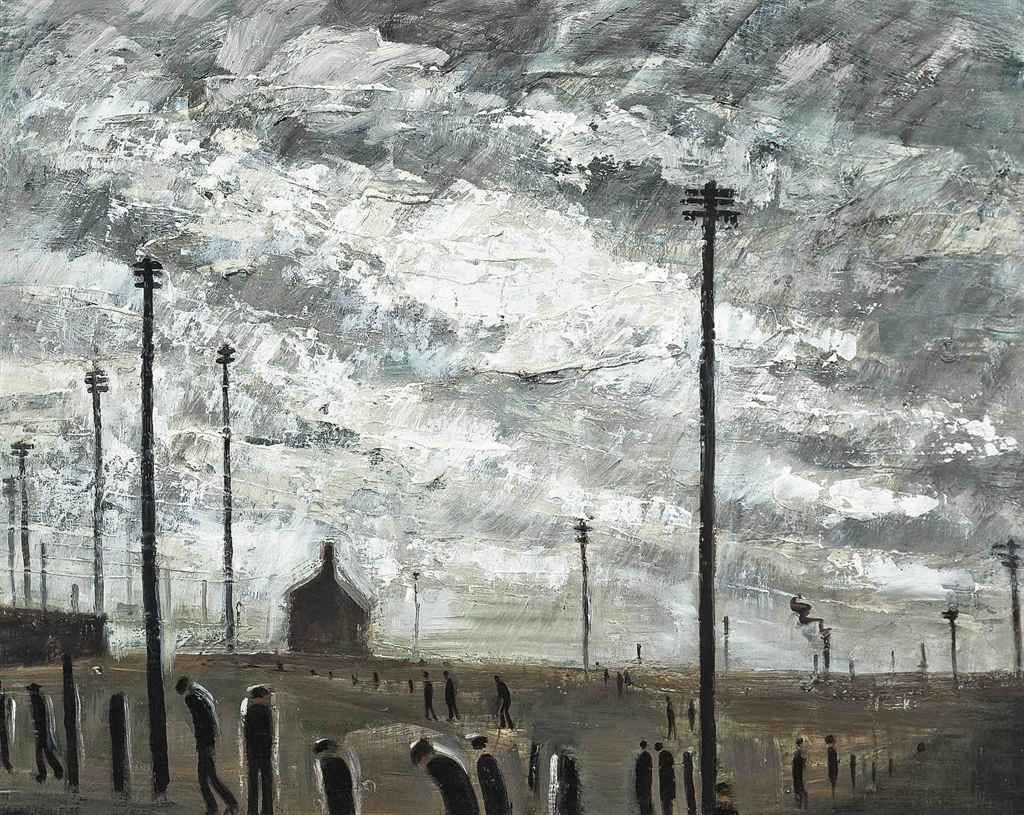
Banner image: © Theodore Major (1908 - 1999) Industrial Landscape with Telegraph Poles. oil on board, 29 x 37 in. (73.7 x 94 cm). Image courtesy: Collect Art Gallery in Lymm, Cheshire.
In TBLM’s Issue 62, V. Ramaswamy’s translation of Hamiruddin Middya’s story ‘Flying in the Sky’ was accompanied by a different image, one of workers repairing a fallen power line. Major’s painting is much closer to the spirit of the story. Most write-ups about Theodore Major mention that his work isn’t well known, but among those who know art well (at this point, John Berger’s lovely essay on Major makes an entrance), it is very much esteemed. And rightfully so. The Collect Gallery has a large number of his works.
A Theodore Major painting is reminiscent of William Blake’s poems. They too depict bleak landscapes with industrial darkness and satanic magic. Unlike the painter L. S. Lowry, his contemporary and friend, Major didn’t paint his sorrows; Major insisted that he only painted the world, but which when done honestly, reveals itself to be sorrowful.

We hope you enjoyed reading this issue of Crow & Colophon. Subscribe for free to receive updates about The Bombay Literary Magazine and notes of a literary persuasion. For information about how to send your work to The Bombay Literary Magazine, please visit our submit page.