
Marking the Moment
Everything is waiting for you

We are told we are now in a ‘new’ year. Really? The latest model seems a lot like the last one, and the one before that, and the one before the one before that. No new months, no extra days— heck, not even the names of the months have been changed. February remains broken; weren’t they going to fix that? The days are numbered in Arabic, the weekdays are from Norse myth, the months honour dead Roman thugs, the centuries are divided with respect to a Jewish guy they murdered, and for some reason, the Babylonians, long extinct, still control how many months we have in a year—what a multicultural mess! In any case, we’ll all now have to do ‘January’-type things, just as we all did ‘December’-type things just a day or two ago. How the other animals must laugh at us.
Still, there is something child-like, touching and even magnificent about all this make-believe, isn’t there? It is this kind of make-believing which has helped our orphaned species cope with the awareness of being aware. All species mark their existence in the world, but ours also make marks to remember the marks we make in the world, and therefore, ad infinitum.
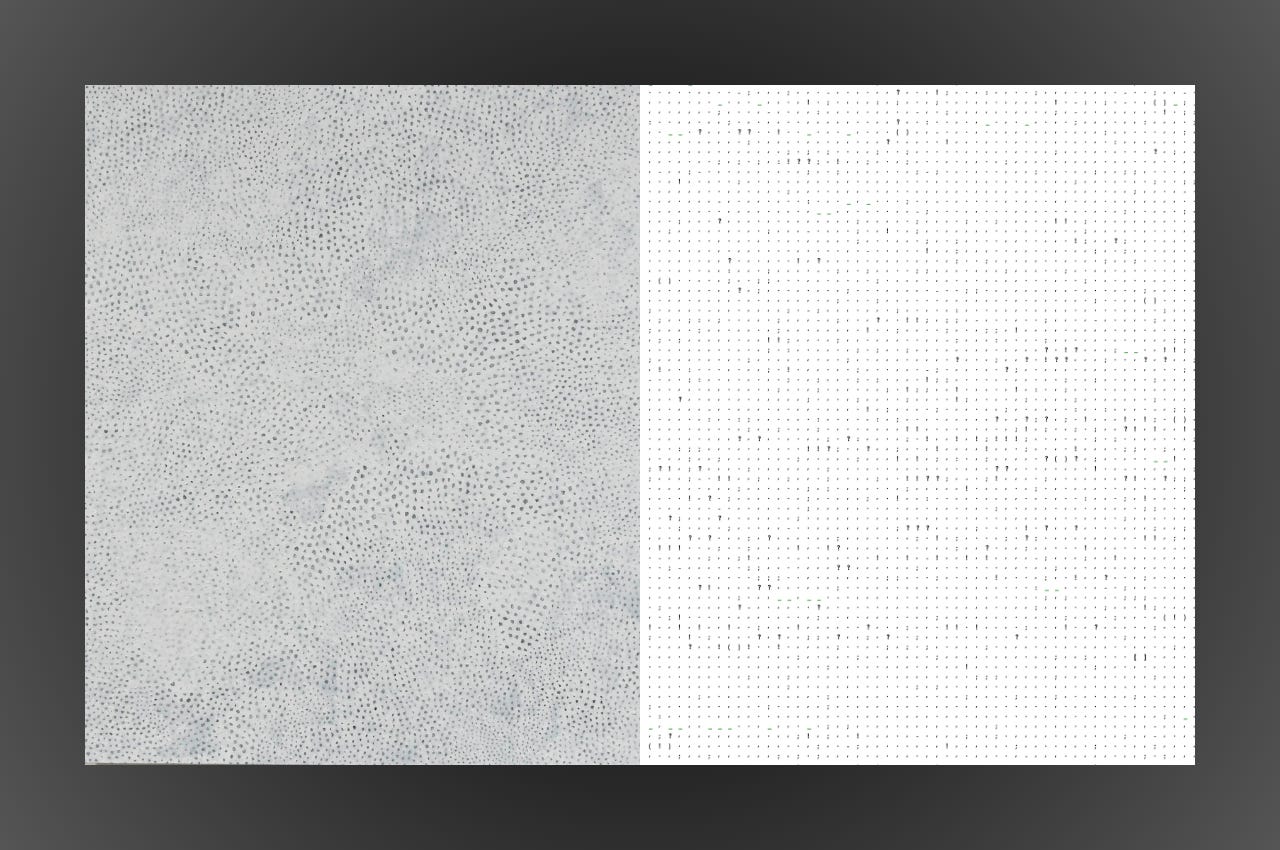
Yayoi Kusama’s paintings come to mind (the left-half of the cover image is an instance). The most minimal of marks, iterated and reiterated, thousands of times—her famed series of ‘infinity nets’— each repeating on the indifferent canvas: I was here and here and here and here…. Stepping back from these paintings, one is reminded of Nicholas Rougeux’s ‘punctuation charts’ which impasto’d the ‘visual rhythm of punctuation in well-known literary works’. For the right half of this post’s cover image, we applied Adam Calhoun’s Python script on Mary Shelley’s novel Frankenstein. Alphanumeric characters were removed, as were line breaks and spaces and only punctuation was retained.
The punctuation marks would mean nothing had they not been made by an author awaiting a reader and interpreted by a reader awaiting an author. As does the darkened text of the universe. Perhaps David Whyte is right when he says in his poem ‘Sweet Darkness’:
Sometimes it takes darkness and the sweet
confinement of your aloneness
to learn
We hurtle through the cosmos, swinging by the graceful commas of spiral galaxies, jumping over the full stops of black holes, puzzling over the aposiopesis of lost photons, and reading this impossibly vast and almost incomprehensible text, we make-believe these marks were made for a reason, a reason which our terrible and wondrous burden of awareness will some day allow us to transcend. Meanwhile, we divide our cosmic passage into chapters and at the end of one and the start of another, we turn to one other and say, with love: happy new year, happy new year.
For us, there is indeed some happiness to share. Siddharth Dasgupta, Visual Narratives managing editor, was shortlisted for the Rabindranath Tagore Literary Prize. Last November, Granta’s influential India issue included work by TBLM’s founder and editor Tanuj Solanki and several TBLM contributors: V. Ramaswamy, Matt Reeck, Devika Rege, Sumana Roy, and Geetanjali Shree.
In other news, fiction editors Anjali Alappat, Uday Kanungo, Dyuti Mishra and poetry Reader Shreyasi have left for other adventures. Bon voyage, friends! We’ll miss your perspectives. Fortunately, the iron law of conservation of editorial mass kicked in and we are delighted to announce that Rahul Singh, Suchitra Sukumar, and Carol Blaizy D’Souza have joined TBLM. The murder is once again most fowl.
What else? Well, TBLM is now reading for Issue 63, our April issue! What, only one exclamation mark!! Three marks for muster barks!!! We’re looking for fiction, poetry, translated fiction & poetry, essays and graphic fiction. Send us your work via the submit form. This time, the poetry editors have a special yen for cartoon-based poetry. Please see the guidelines for details.

Perhaps you find yourself hesitating. You wait, when it is the world who is waiting for you, as David Whyte tells us in another of his poems:
Put down the weight of your aloneness and ease into the
conversation. The kettle is singing
even as it pours you a drink, the cooking pots
have left their arrogant aloofness and
seen the good in you at last. All the birds
and creatures of the world are unutterably
themselves. Everything is waiting for you.
It is true we can remake ourselves with deep insight, but perhaps the borrowed wisdom of others can be equally effective. If so, this post’s colophon, three marks of wisdom by therapist, screenwriter and author Dennis Palumbo, may be of use. Read, weigh, work: we will wait.

Colophon: The Three Cosmic Rules of Writing
DENNIS PALUMBO
As a veteran writer and a licensed psychotherapist specializing in writers’ issues, I know enough to know there aren’t any rules when it comes to writing.
Except for the following, which I modestly call the Three Cosmic Rules of Writing. I’m serious. Learn these simple rules, then burn them into your hearts and minds. It couldn’t hurt.
The First Cosmic Rule: ’You Are Enough’
It’s a growth industry: there are dozens of seminars, how-to books and audio tapes promising to teach you to write better, faster, more commercially. And there’s nothing wrong with most of these. I know; I teach some myself.
Because, frankly, there are things a writer needs to learn about craft, the traditions of storytelling and the reality of the marketplace. But for the writer just starting out, there’s a hidden danger: namely, the belief that if you just take the right seminars, read the right books or pick the right guru, then you’ll be successful. That the person you are right now just isn’t enough.
It’s a classic belief system...writers who feel they have to be something more to succeed–smarter, better educated, funnier–with more interesting lives, more unique experiences. More.something.
As a therapist who works with writers, I see this everyday. Writers who feel they’re somehow not enough. Who believe all the other writers are more talented, more confident, less burdened by doubt.
It puts me in mind of that famous opening sequence of Woody Allen’s ’Star-dust Memories.’ A glum Woody sits in a dark, dingy train car, with other lost souls. Looking out the window, he sees another train car–shining, brightly lit. Inside, beautiful men and women laugh and drink champagne, a festive vision of wit and privilege out of a Noel Coward play. Woody despairs. Why isn’t he in the sparkling car, with the sparkling people?
Once, when a writer client of mine made reference to this scene to explain his feelings, what emerged was not only his sense of himself as inadequate, but something else, more insidious and undermining. Namely, the idea that he’d been dealt a bad hand– ’I’m in the wrong car’–because of intrinsic defects in himself. If he were a better writer – smarter, more talented, whatever—he’d be in the right car. Those happy, glittering people were in the shining train car because they deserved to be there while he did not.
Thereafter, in our work together, his self-sabotaging behaviors could be un-derstood as a natural result of his belief in himself as basically defective. When this painful self-concept was successfully illuminated and challenged, things be-gan to shift in his view of himself.
What this anecdote illustrates is the real danger to your writing in seeing yourself as less than, not enough. Admittedly, a very common, self-limiting belief. To which I offer this thought, which will save you thousands of dollars in therapy bills and trim years off your spiritual journey: everybody thinks the party’s happening somewhere else.
But it isn’t. It’s happening right here, right now. With you.
You–with all your doubts and fears, joys and sorrows–are enough. You–the one reading these words at this very moment–have everything you need to become the writer you want to be.
’Me?’ you may be asking. ’Just as I am?’
Yes, you, who may, at this moment, be feeling scared, frustrated, blocked, discouraged. If so, join the club. Because so does every other writer in the world, even the most successful ones, who, after all, were once struggling writers themselves.
And now that they’re successful, guess what? They still struggle. They have the same doubts, fears, longings, worries. They just don’t give these feelings the same negative meanings you do. Smart writers recognize their feelings as important information about their inner lives, as the raw material of their writing craft. Just grist for the mill.
Which brings me to the Second Cosmic Rule of Writing: ’Work With What You’re Given’
One of my favorite New Yorker cartoons by George Booth depicts a tor-mented, obviously ’blocked’ writer sitting at his typewriter, crumpled paper strewn about, surrounded by literally dozens of dogs–napping, barking, hang-ing from the window sills, etc. The writer’s wife stands in the doorway, glaring at him in weary disdain. ’Write about dogs,’ she says.
Aside from its dark humor, the cartoon’s truth is that the frustrated writer often doesn’t see that a subject for his writing is right in front of him–the dogs; i.e., the obvious elements that actually inhabit his life.
In other words, work with what you’re given. Writers have to practice SEE-ING, really seeing the world around them. As a writer, your job is to do this consciously and artfully, using craft and imagination as well as memory and reflection. You have to pay attention.
Tolstoy said, ’Love those whom God has put before You’; the Tao says, ’Love the Ten Thousand Things.’ In short, love, that is–see–everything.
What do I mean by this? To ’love’ the totality of what we experience is to accept all our responses to it, to be enlivened by the variety of ways we experience events, good or bad, painful or joyful. The artist’s task is to see every moment – and our reaction to it–as potentially interesting, challenging and worthy of our creative participation.
Viewed from this perspective, a writer is never bored, never longs for things in his or her life to be more exciting, more interesting, more something else than they actually are. Except, of course, when you DO feel that way, in which case you should write about that boredom or that longing. That’s your grist for that particular day. It’s working with what you’re given.
Which brings me to the Third (and, thankfully, last) Cosmic Rule of Writ-ing, namely, ’Writing Begets Writing.’
If you’re stuck on a difficult scene, write it anyway.
Writing begets writing. Just as worrying begets worrying. Obsessing begets more obsessing. Pacing back and forth begets–well, you get the idea.
When you risk writing from where you’re at, you set in motion a whole set of internal processes. The first rotten sentence you write has a life you can inhabit, evaluate, cross out. This first attempt can be replaced by a second, hopefully less rotten sentence–maybe a good piece of description or a sharp line of dialogue.
Then again, maybe not. But it doesn’t matter. Just keep going. As William Goldman reminds us, some scenes you write are just going to be sludge, but they’re important connective tissue. They keep things moving; they’re links in a chain. Weak links, perhaps, but you can always go back and strengthen them later.
With what? The knowledge that you’ve written, for one thing, because writing doesn’t just beget writing, it also begets–and reinforces–the reality that you can write; that pages will accumulate.
Look at it this way: Every hour you spend writing is an hour not spent fretting about your writing. Every day you produce pages is a day you didn’t spend sitting at a coffee shop, bitching about not producing any pages.
Writing begets writing. Not writing begets...well...not writing. You do the math.
‘You Are Enough.’
‘Work With What You’re Given.’
‘Writing Begets Writing.’
Which all point to one rule, really. Write now. Don’t wait. Write now. And keep writing.
Source: Writers Store. November 24, 2020.
--
DENNIS PALUMBO is a licensed psychotherapist in private practice, specializing in working with creative patients. His award-winning series of mystery thrillers—the latest is Panic Attack—feature psychologist and trauma expert Daniel Rinaldi. He is also the author of Writing From the Inside Out, as well as a collection of mystery short stories, From Crime to Crime. Recently, he served as Consulting Producer on the Hulu limited series The Patient. His short fiction has appeared in Ellery Queen’s Mystery Magazine, The Strand, Mystery Weekly, and elsewhere. His work helping writers has been profiled in The New York Times, Premiere Magazine, GQ, The Los Angeles Times, and other publications, as well as on NPR and CNN. [source: Psychiatric Times (excerpted)]

We hope you enjoyed reading this issue of Crow & Colophon. Subscribe for free to receive updates about The Bombay Literary Magazine and notes of a literary persuasion. For information about how to send your work to The Bombay Literary Magazine, please visit our submit page.