
Nothing But The Truth
The Writer’s Sleight of Hand
Crow News:
Same old, same old. Work, work, work. Churn, churn, churn. See Crow swoop. See Crow droop. In short, friends and fellow lifeforms, the editors at TBLM’s World Headquarters continue their text march. We’ll have some admin updates, some comings and goings to share in the next SubStack post. For now, we’re focused on putting together the next issue. We have just two more weeks before we send out updates to the writers. (If you have sent your work and haven’t heard from us by August 1, you can reach us at help@bombaylitmag.com.)
Suppose you are trapped on an island with a Knight and a Knave. The Knight always tells the truth and the Knave always lies, but you don’t know which one is the Knight and which one the Knave. Both claim to know how to exit the island. Who to trust? What to ask? In his books on the reliably unreliable, the logician Raymond Smullyan demonstrated that it wasn’t necessary to identify the Knight or the Knave. The right questions along with a little introspection could still lead to freedom.
About phreedom: on the Isle of Literature, poets never lie, we all know that. A poem is truth’s distilled sweat. On the other hand, prose writers….Let’s be honest, they’re the offspring of a lesser God, aren’t they? With fiction, readers discover themselves on Smullyan’s island, do they not? Here is the narrator, saying this, saying that. Here is the story, not saying this, not saying that. Who the Knave and who the Knight? What is the truth, really? Pervin Saket talks about this interplay in her reading of Jeff Ronan’s intriguing story ‘Shell Game’. She’s a poet, so there’s no tricky business to worry about. Onwards to the island.
Pervin Saket | Nothing But The Truth
The Writer’s Sleight of Hand
‘I didn’t know going in that the job involved how well you can lie to people.’ This is the first line of Jeff Ronan’s story ‘Shell Game’. Well, I didn’t know going in that this story was about a prankster, so inhabiting the mind that I do, I assumed, just for a second, that the job in question referred to writing. I don’t mean it pejoratively, but in the way fiction has always used imagination and craft as a way to get to a truth that is more than just facts. Once upon a time there was a girl called Cinderella? No, there likely wasn’t. All happy families are alike? Very debatable. In fact, I still remember when I was in school and someone fibbed, they weren’t called a liar (we weren’t allowed to use ‘four-letter words’), but a storyteller. “Such tall tales, what a storyteller you are!”
Perhaps my mistake turned out to be useful because with every reading I found that Jeff Ronan’s story offers more insights about writing than it first lets on. About half stories, hidden stories, duplication and foreshadowing and sideshadowing, about the careful revealing of information at the right time, at the right turn. The point of view follows Ian, who works as a production assistant on a hidden-camera television show. His job is to lure unsuspecting strangers into elaborate practical jokes. One day he recruits a lonely man called Jimmy, leading Jimmy to believe he is participating in a medical survey, only to have the prank spiral into something darker. All through this narration, the story weaves in other pranks, including Ian’s memories of his uncle TJ, a jovial prankster, whose private suffering Ian accidentally witnessed as a child.
The actual pranks, expectedly, involve concealment, substitution and surprise. But as I read along, the story prompted me to think about how this narration in particular, and how stories in general, resemble similar processes. We see them constructed through carefully-timed revelations or strategic omissions, and yet these turns are forgiven, they are delightful even, because a story is never in service of linear facts; it wants to uncover what they mean. And we leave knowing, just like with the conjurer, puppeteer or illusionist, that the hidden or silent parts of a story are more honest than what is visible. In this case, uncle TJ’s sorrow, witnessed momentarily and unwittingly by an uncomprehending child, or Jimmy’s disappearance after the prank hits a nerve.
Every turn is designed to draw the reader’s eye in one direction, while real human drama is playing out elsewhere, out of sight. Read this way, ‘Shell Game’ becomes an ars poetica unveiling through a series of big and small turns. It reminds us that every act of storytelling incorporates elements of narrative deflection, not because writers wish to conceal, but because some truths are to be approached from the corner of the eye.
Colophon: ‘Shell Game’
JEFF RONAN
I didn’t know going in that the job boiled down to how well you can lie to people. It gave new context to Hunter’s text that I’d be “perfect for the show.” When he first messaged me about Prankers Aweigh, I pictured myself lounging on a cruise ship, sipping margaritas while convincing wealthy vacationers we’d been boarded by old-timey pirates. Instead, we shoot in a faceless blur of strip malls throughout the tri-state area, and in the few weeks I’ve been working on the show, no one has been able to explain the nautical title.
Hunter’s aunt produces Prankers, which is how he helped get me the job. Our not-quite-relationship trailed off into an ellipsis of an ending months ago. I had hoped the job offer might be his attempt at rekindling things, but on the first day of shooting I began to suspect that he hadn’t meant it as a kind gesture. That I, in fact, was the one being pranked.
“Excuse me, do you have a moment…”
The woman looks at me as if I’ve flashed her, hustling into the nail salon next door. Today’s shoot is in West Milford, where we’ve converted an empty storefront into an innocuous-looking office. We advertise paid studies online to entice potential marks – $200 for 1 hour of your time!! – which is more than I’ll make for the day. The three people who had signed up were all no-shows, prompting our director Lane to launch a wastebasket across the room, almost hitting Becca, my fellow PA. The twins who will both be playing Doctor Nolan in the prank looked up from their phones and then back down in unison, as if they’d rehearsed the motion. Maybe they had.
“Oh my god, you guys would be perfect for this!”
Becca chats up two hungover frat boys, oblivious to the fact that they’re more interested in her cleavage than in the paid study. We’ve been in front of the strip mall for two hours and have barely seen any foot traffic. Humidity blankets us; I can feel the wet spots under my arms growing by the second, beads of sweat trickling down my sides.
My previous experiences with pranks were all on the receiving end while growing up: my locker superglued shut the morning of midterms. A book report stolen from my backpack and replaced with printed screen grabs of gay porn. Back in eighth grade, everyone in homeroom spent a week pretending that I didn’t exist. That one I secretly enjoyed before our teacher caught on and made them stop.
The only pranks I ever really liked were played on me by my uncle TJ, a big man with a bushy beard and static shock hair like a cartoon lion. When I was in grade school, he came to live with me and my mom for about a year. He liked to buy duplicates of random things in the house – my mom’s sneakers, the stuffed pterodactyl I carried everywhere – and hide them somewhere for us to stumble upon. When we eventually realized we now had three identical spatulas spread out among different drawers he’d throw his head back, howling with a laughter so infectious you couldn’t help but join him.
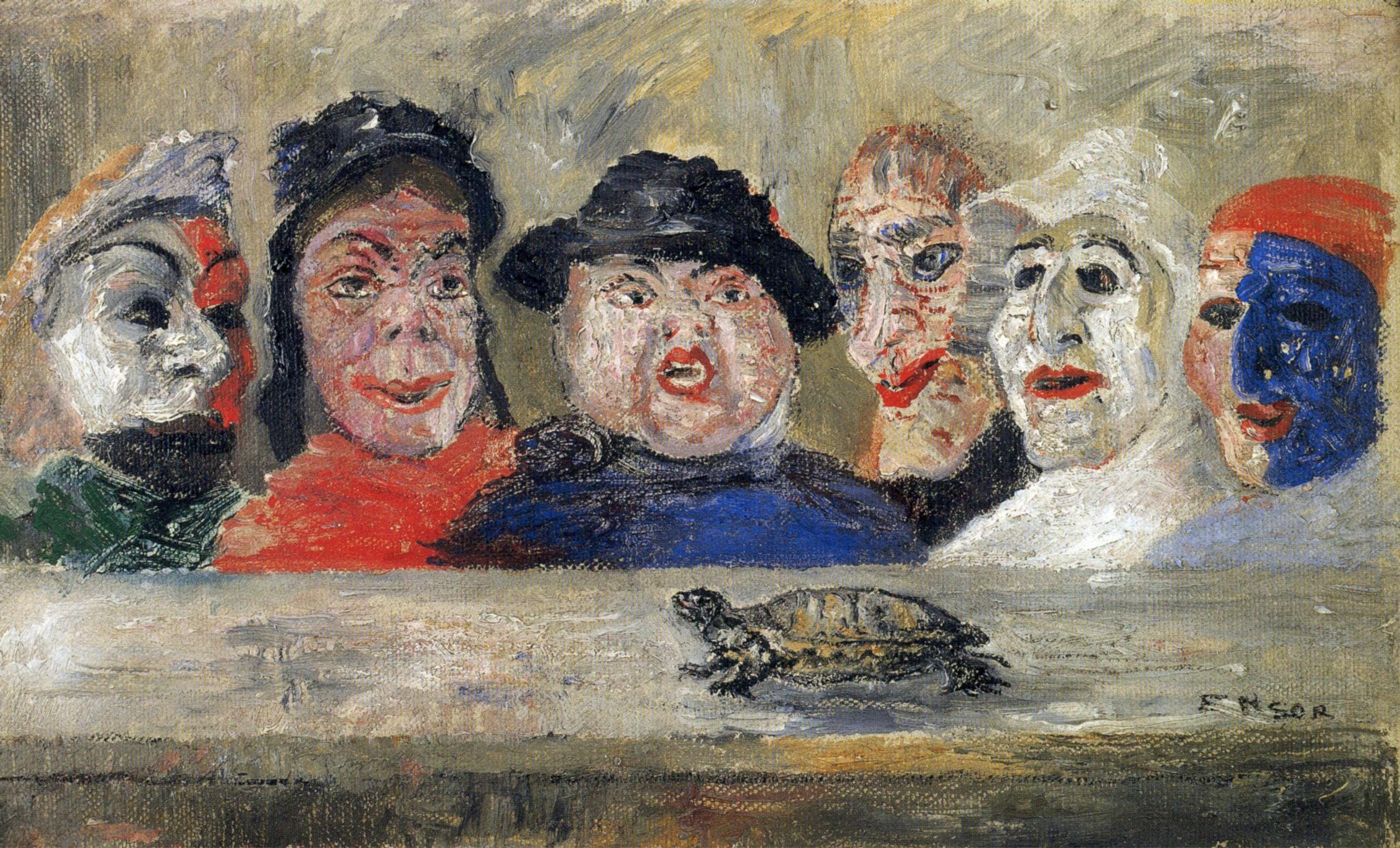
The prank I loved most wasn’t even one of his own, but a story he would tell me. This painter in France had gifted a woman a pet turtle so small that it fit in the palm of her hand. While she was out, he broke into her apartment and swapped it with one double its size. Over the weeks, he’d continue to break in, each time switching them out for larger and larger turtles. By the end of the month, this turtle had seemingly shot up to the size of a Shetland pony. She would parade it around town, showing off her miracle pet to all the neighbors. I’d make my uncle act out the story, culminating with me riding on his back as he crawled around our house. “All a-board, monsieur Ian!” he would announce in an awful attempt at a French accent, and we would both laugh until I couldn’t hold on any longer.
The frat boys wander off into the 7-11 at the corner of the strip mall. The parking lot shimmers in the heat, my eyeballs beginning to sizzle in their sockets like a pair of fried eggs. I wonder if they’ll still pay me for the day if I feign heatstroke, figuring I’m close enough to the real thing anyway. As I debate this, a guy in his forties walks towards us, lost in thought. His patchy beard and ancient hoodie give both ‘hipster musician’ and ‘lives out of his van’ vibes.
“Hi!” Becca chirps. “Two-hundred dollars for an hour of your time!”
The man looks up, startled. “What?”
“Two-hundred dollars for an hour of your time!” Becca repeats with her hummingbird energy. The man looks to me, as if for help.
“We’re doing a paid study,” I say, gesturing to our storefront. “If you’re free.”
“Oh. I don’t know…maybe?” he says, punctuated by a high-pitched yip of a laugh that almost makes me take a step back.
For potential marks, Lane prefers woo girls, dudebros, and sassy aunt types – his phrasing. He won’t like this guy, whose off-putting vibe reminds me of those frogs that secrete toxins to keep predators away. But I’m melting in the heat, and all I can think of is the sanctimonious look Hunter used to give me when I insisted that I could solve my own problems, as if I could fool myself but not him.
“You’re just the type of guy we’re looking for!” I say, overdoing the enthusiasm. “I’m Ian.”
“Jimmy.” A shy smile spreads across his face. “Um, sure, why not?”
“Fantastic!” I’ve apparently been possessed by a game show host. “So, like Becca said, it’ll take about an hour. We’ll just be asking you a few questions.”
“What kind of questions?”
“Nothing crazy,” I say, for some reason adding, “and it’s all anonymous.”
He tells us he needs to pick some things up at the dollar store but will come by afterwards. Once he leaves, Becca grins at me, her hand outstretched for a high five. “Good job, partner!” I ignore her and head inside to tell Lane to start setting up.
#
To give Hunter credit, lying to strangers does come easily to me, though it leaves me feeling vaguely ill. Tricking someone with money troubles into thinking they’ve found a way to make a quick buck, only to turn them into a laughingstock on TV, feels incredibly shitty. I remind myself that I don’t know what’s going on in these people’s lives, that what seems humiliating to me may not even register to them. After all, it’s a relatively easy way to earn two-hundred dollars (and more than I’ll be making, lest we forget).
My uncle TJ had money troubles too, which played a large factor in him coming to live with us. I was too young to understand the reasons at the time, I just hoped he’d never leave. With him around, our house, so often shrouded in silence, became a cacophony of noise. He had a restless energy, always searching for new means to disrupt our routine quiet.
One of his favorite ways was to squeeze his large frame into the unlikeliest of places and leap out to surprise me and my mom. I grew determined to scare him back, so one afternoon, I climbed into the tub and slid the shower curtain shut, waiting almost an hour with the single-minded focus of a child with nothing but free time. I finally heard his heavy footsteps approach, followed by the door shutting and lock clicking into place. As I got ready to burst out, my uncle made a soft, strangled noise, like an animal caught in a trap.
I edged closer to the small gap between the shower curtain and the wall. He hunched over the sink, his shoulders jostling up and down. “Stop it…stop it you piece of shit…” he muttered under his breath. A sob escaped him. Then another. He quietly wept, his hands gripping the sides of the sink. I’d never seen a grownup cry before. I wanted to say something, but I felt like I’d get in trouble, like I wasn’t allowed to be seeing this.
He pushed the heels of his hands into his eyes as if trying to force the tears back in. His breathing eventually slowed, steadying. He grabbed a handful of toilet paper, wiping away tears and snot. When he looked back at the mirror, I barely recognized him. His jaw hung slack, his eyes dark. Who was this stranger who had replaced my uncle? He jabbed a finger at his reflection and quietly hissed something so emphatic that spittle hit the glass like a shotgun blast. I pulled away from the shower curtain, hands clapped over my mouth until he left.
I waited a few minutes before shakily getting out of the tub. When I found him in the living room, you’d never guess anything had been the matter. “There’s my little buddy!” he crowed, his arms splayed for a hug. I ran into his arms, trying to forget what I’d just seen.
A few weeks later, TJ moved back into the city, despite my mother’s protests. He wrapped her in a bear hug, joking that he’d be a burden to us no longer as he swung her around. We saw him off at the station, waving to him from the platform. As the train lurched into motion, he mimed steering as if he were the conductor, a manic grin fixed on his face until we lost sight of him. I’m almost positive I imagined it, but I have the clearest memory of his smile wiping away into blankness just before he was fully out of view.
#
“He’s a weird-lookin’ guy, isn’t he?”
Our crew had divided the space into a small waiting room and an office where the prank will take place. Tucked in the back is a tight nook where the rest of us hole up, cramped and sweating. The twins flap their lab coats, trying in vain to circulate air. Jimmy waits in the office, drumming his fingers on his thighs. He’s mouthing something to himself, though watching from the screen I can’t tell what he’s saying.
I lean away from Lane as he squints at the monitor. “Sheesh, Ian. You couldn’t get someone normal?” I want to tell him he’s more than welcome to find someone else but bite my tongue. He taps one of the twins on the shoulder. “You’re up, Casey.”
“I’m Sean.” He points to his brother. “That’s Casey.”
Lane runs a hand through his hair. “Whatever. One of you get in there.” Sean shrugs and presses past us, exiting into the waiting room.
Today’s prank is a variation on a magician’s doubles act. Hire a pair of twins, dress them identically (in this case a doctor’s outfit), and convince the mark that the conversation they just had never happened. We watch on the monitor as Sean knocks one-two-three on the office door and enters, introducing himself to Jimmy as Doctor Nolan. Sean runs through the list of introductory questions, circling around Jimmy towards the hidden partition our crew built into the back wall. Lane signals for Casey to get ready.
“Now,” Sean says. “Do you or your family have any history of hallucinations?”
Jimmy twists around in his seat to look at him. “Sorry?”
“Hallucinations. Seeing things that aren’t there.”
“Me or my family?” Jimmy sucks on his lower lip. “Well…uh, not exactly.”
Casey knocks on the office door the same way Sean had, one-two-three. As Jimmy turns toward the sound, Sean slips out of sight behind the partition. Casey enters, repeating his brother’s delivery and mannerisms as he introduces himself as Doctor Nolan. He apologizes for the delay and asks if Jimmy has been waiting long. Jimmy stares back at him, his mouth opening and closing like a fish. “Weren’t you just…” Jimmy looks back to where Sean has just been standing, seeing nothing but wall.
Lane snorts. “Awesome, the guy has no clue what just happened. Push in on camera two.” As we zoom in on Jimmy, the muscles in his face go limp, his features appearing to melt downward into the floor. He pulls at the fabric of his jeans, fists tight. Casey doesn’t notice and starts running through the same list of introductory questions. When he asks Jimmy if he or his family have a history of hallucinations, Jimmy squeezes his eyes shut but otherwise doesn’t respond. Casey clears his throat and repeats the question.
“What’s wrong with him?” Becca asks, but nobody answers. I press closer to the monitor, watching as Jimmy’s breathing quickens. The air is heavy around me; I’m choking on it.
“Sir?” Casey asks.
Jimmy looks up at Casey, his eyes cloudy and faraway. “This is anonymous, right?” My throat tightens. Why did I tell him that? “Because things usually feel so real, y’know? Like real real. But other times, I don’t know…” He swallows. “I just don’t know anymore…” He slumps, his mouth twitching back and forth as if trying to stop an insect from escaping between his lips.
Casey glances at one of the hidden cameras, but we have no way to signal to him. “So,” he says with a forced smile, trying to get things back on track. “Can you think of any time recently that you might have hallucinated?”
Without warning, Jimmy pitches forward and begins throwing up.
#
A few years ago, I looked up the turtle prank on a whim and discovered my uncle had only told me the first half of the story. The artist broke back into the woman’s apartment and replaced the giant turtle with a slightly smaller one. A few days later, he did this again. And then again. Over the weeks, it looked like her miracle turtle was wasting away. No matter how much she fed the thing, it was disappearing before her eyes.
The artist broke in one final time, stealing back the original turtle he’d gifted her. Only this time, he left nothing in its place. The woman must have searched every room of her apartment, gently lifting each piece of furniture, fearful of crushing it. Did she ever realize what had happened, or did she think the turtle had shrunk to the microscopic level, slowly marching alongside the dust mites trapped within the carpet fibers, lost, but not all gone?
I buy Jimmy a Gatorade from the 7-11 while he cleans himself up. When I get back, he’s sitting in the waiting room, staring at his feet. Someone has given him a large Prankers Aweigh shirt which balloons around his thin frame. The air carries a lingering trace of vomit. “Thanks,” he says when he notices me holding out the drink. He chugs a third of it, then sighs heavily, a quiet belch escaping his lips.
“Are you ok?”
“I’m fine,” he says too quickly. “Must have eaten something weird,” he adds before emitting another high-pitched laugh.
After Jimmy got sick, Lane sent both the twins in to explain that he was on a prank show. He smiled and nodded as if he were in on the joke, but something in his eyes unnerved me. Like we’d wedged open a door that he had worked hard to keep locked tight.
I’m not sure how to phrase the question I really want to ask, so instead I say, “Is there anything else I can do for you? Anything you need?” He finally looks up at me. I don’t know what he sees in my expression, but his eyes begin to water, and he turns away without answering.
Lane pokes his head in. “How we doin’ in here?” Without waiting for a response, he pulls a crumpled handful of bills from his pocket and holds them out to Jimmy. “Here you go, man. Two-hundred big ones for your trouble.”
Jimmy takes the money and shuffles out the door without a word. Once he’s gone, Lane rolls his eyes and looks back at me. “Yeesh. C’mon, let’s start breaking shit down.”
“I’m going on a smoke break,” I say, bolting out the door before Lane can remember that I don’t smoke.
After my uncle moved out of our house, I only saw him once more, that Thanksgiving. He seemed muted throughout dinner but would spring to life as soon as someone addressed him. I looked around, but no one else saw how practiced his laugh sounded – too loud, too forced – a copy of his usual self. Or had he always been like this, and I only noticed once I’d had a peek behind the curtain? I asked him after dinner to reenact the turtle prank, but he said he wasn’t feeling well, maybe another time.
A week later, he packed a single suitcase and left the city, leaving the rest of his things behind. He left no note to explain where he was going or how to get in touch. I’ve never told anyone about seeing him break down in the bathroom, but I’ve often wondered what would have happened if I’d come out from behind the shower curtain. If my uncle knew that I’d been there with him.
I don’t see Jimmy when I get outside. A crumpled piece of paper drifts by before I realize it’s one of the twenties Lane gave him. As I bend over to grab it, I spot the rest of the money in a pile on the curb, abandoned. My stomach drops, and I break into a run. I’m suddenly desperate to find Jimmy, though I have no idea what to say if I do. I scan the windows of the nail salon, the Chinese restaurant, the 7-11, the dollar store. No sign of him. I race through the parking lot, peering into the parked cars. Somewhere in the distance, Lane is shouting my name. I shield my eyes from the sun, struggling against the glare, but it’s no use. Jimmy has disappeared, as if he’d never been here at all.
Source: Jeff Ronan, ‘Shell Game’, TBLM Fiction | Issue 63.
—
JEFF RONAN is a writer and actor living in Brooklyn, New York. His stories have appeared in over a dozen publications and anthologies including The Saturday Evening Post, Philadelphia Stories, Neon Door, Matter Press, Short-Story, Twenty-Two Twenty-Eight, and Metastellar. His play Bunkmates is published and licensed by Concord Theatricals. [Text source: Jeff Ronan]
ACKNOWLEDGEMENTS:
Image credits: James Ensor (1860-1949). Masques regardant une tortue [Masks looking at a tortoise], (1894). Oil on canvas laid down on panel. 2.2 × 37.4 cm (8.7 × 14.7 inches). Image courtesy, WikiArt.

James Ensor’s paintings are what you would get were Hieronymus Bosch to be dragged into the 19th century, trapped in a small, overly-tidy Belgian town, forced to teach night classes, be ignored by critics, and denied even the melancholy consolations of the flesh. You get, in short, great art. Absurd, surreal, carnivalesque, medieval art.
Naturally, Ensor loved masks. He loved painting creepy-looking people. He had the cheerful morbidity common to people who know they’re too degenerate to die early. He had an English father; this could explain why self-flagellatory writing was another of his vices. About one of his paintings, The Temptation of St. Anthony (1887), Ensor wrote: “I’ve added a few hundred more figures: ghastly devils, horrible animals, revolting and obscene monsters. I am very pleased.” So were we when we discovered a match between one of his paintings and Jeff Ronan’s story.

We hope you enjoyed reading this issue of Crow & Colophon. Subscribe for free to receive updates about The Bombay Literary Magazine and notes of a literary persuasion. For information about how to send your work to The Bombay Literary Magazine, please visit our submit page.
What a story of complete heartbreak. Punch in the gut even though you knew where it was heading. Beautifully, magically executed. I loved it.