
Today It's My Ankle
Or, How to Divide a Body
Crow News:
Two more weeks for Issue 64. Then it’s yo ho ho and a bottle of rum. This ship sails because of our sailors who trim their wind-given words, but now that harbor is in sight, the closer we get to the shore the farther away arrival seems. For God’s sake, Noah, are we there yet!!
We are bidding farewell to two wonderful editors. Kunjana Parashar, who joined TBLM four years ago and was managing editor of the Poetry Team from Issue 60 onwards, and Sandip Baidya, associate editor (Poetry). A lit mag is something of a Ship of Theseus, but dem knowing and dem feeling are two dem different things. We’ll miss you, friends. Thank you and fair winds for all your journeys.
There’s more rejiggering to report, but for God’s sake, Noah, are we there yet!!
Fortnightly Freudenfreude:
Soumya Mukerji, whose lovely photoessay Way of the Wa: In Harmony with Japan we’d published in Issue 57 (April 2024), has a new book of eco-poetry out. It’s called Cries (Westland Books, 2026) and you can pick up your copy here.

Congratulations, Soumya!
Speaking of motion and emotion, in a quite precise sense, we’re all ships of Theseus, hauling the cargo of imagined selfhood despite the ongoing, ceaseless overhaul of our cellular multitudes. Illness awakens us, and though we may return to slumber, our scars serve as memory of that awakening. In this post’s colophon, Pervin Saket has picked Arunima Tenzin Tara’s story from Issue 63. A story of a chef, a woman, an ill woman chef, an ill woman chef in an ill society. So let’s turn to her reading of the ship’s planks.
Pervin Saket | Today It’s My Ankle
Or, how to divide a body
A couple of months ago, Polycystic Ovarian Syndrome (PCOS) was renamed Polyendocrine Metabolic Ovarian Syndrome (PMOS). I discovered this through a reel posted by my OB-GYN, which was followed by a cascade of celebrations and comments. It wasn’t a cure or even a new drug announcement. Just a renaming of something most people had never heard of, and with just one letter changed in the abbreviation. And yet, for thousands of women, including myself, it felt like everything. Because finally, medical terminology was recognising what we had known all along—the organ is not the whole story. The person is not the sum of her parts.
‘Red Right Ankle’ by Arunima Tenzin Tara begins with the narrator confessing:
Every day I begin to feel more like a collection of organs and less like a person.
Right now it is her ankle, her red right ankle. But soon, the story will introduce other body parts: ligament, uterus, nerves, stomach, blood, liver, bones. Set over the course of a single day, the story follows a chef who navigates chronic pain, repeated medical dismissal, the relentless physical demands of working in a professional kitchen and the collapse of a relationship strained by infertility.
I won’t even get into medicine’s long history of neglecting women’s health. (Okay maybe I’ll get into just one Did-You-Know: it was only in 2023—yes, as recent as after the Covid vaccine—that researchers at Oregon Health and Science University first tested menstrual products using actual menstrual blood.)
While the story gestures towards a biased medical system, it also weaves in the politics of surveillance. Each time the narrator needs an MRI or ultrasound, the hospital insists on her Aadhar card, and while she initially resists, eventually the pain is just too much. Then there is the need to prove citizenship, which, when confirmed, comes with the State’s expectations from the female body:
On the news the leaders of the majority party warn that the majority religion is no longer the majority. They are the ones running surveillance on our lives, and when they say, you the women of the majority are not doing your job, I know they are talking to me. Three children each, that’s the minimum they will accept to save ourselves from an invasive minority.
Each institution—the hospital, the restaurant industry, the government—demands the same thing in different words: Does this body belong? Can this body work? Will this body reproduce? Function replaces personhood, as seen in the narrator’s repeated suspicion that ‘the parts of me and the sum of me are in conflict’.
There is already enough to admire in this. And yet, for me, one of the delights of a first person narration is to be able to see what the narrator-protagonist might not. Their blind spots. Their own contradictions.
I’m thinking specifically of the narrator’s profession as a chef, and the ways in which her training would likely have taught her to see bodies as parts. A goat becomes shoulder, loin, rib and shank; a fish becomes fillet, roe or head; a chicken is treated as breast, wing, thigh. The menu probably further reduces even the anatomy to just ‘protein’, just a nutrient for the consumer. In this light, the narrator’s opening sentence acquires a different resonance for me. An irony almost. The language that she objects to is also the language of her training, her profession. On these pages, healing and feeding, politics and patriarchy, victim and agent all begin the same way. By breaking a body into parts.
Colophon: Red Right Ankle
ARUNIMA TENZIN TARA
Every day I begin to feel more like a collection of organs and less like a person. The parts of me and the sum of me are in conflict. Today it’s my ankle. The right one. It’s swollen.
No it isn’t. Yes, it is. No. Go to work.
I will, I know I must. It’s my first week at the new restaurant and I can’t be late. But where did I leave the measuring tape? It’s supposed to be on the bedside table. Ready, accessible. Constant surveillance. That’s how I live. Me and the State. I learnt from the best after all.
They take my Aadhar Card for every scan. They note down the number at the bottom of the card every time I ask for an MRI, an ultrasound. I used to say no. I’d argue, before. Back when the ankle wasn’t so swollen, the pain more erratic. I had the energy for debate then. I’d say you don’t need my Aadhar card number. The woman at the reception would look blankly at me, as if I’d suddenly switched to a language she didn’t speak. She’d talk slowly, enunciating as if we are not both speaking in our native tongue. She could have held an ice cube in her mouth and I’d still recognise the words.
“The form won’t go through without the Aadhar card number.”
“No, the form won’t go through without a twelve-digit number. Just type 000000000000. It’ll work.”
“I’m sorry, it’s against company policy.”
Now I just give in. Take it. Fill the form. Make the bill. Let me pay so you can see through me and save the data in your porous cloud. I’m too tired. This is paranoia anyway, isn’t it?
“Your data is safe with us ma’am.”
She can read my mind. Maybe I’m not the first one to try and say no? Consent lingo hasn’t quite made it big here yet. Odd, one would think the medical industry would be the first to jump on the consent bandwagon. Or maybe not. Doctors know best. It’s customer is always right, not patient. Mine is a reluctant, reticent no; a tired one, half-hearted because it’s been rejected so many times before. She doesn’t take it seriously. Even she knows it’s a yes.
Get with the program please miss. She smiles in Lakme’s 9 to 5 range. I nod in yesterday’s eyeliner.
“Just sell it,” I say at last, as I tap my phone and pay. Sell my medical history to the big men who run the country. No, not those men. The ones in government? They can’t run shit. Sell it to the pharma company. The ones who now know that I am crippled by pain, by anxiety, by delusions. They’ll come for me, they’re already on their way. With their algorithms and medicines.
Will they scold me for wasting resources? Will they ask why I felt the need to have three MRIs in three months? Or will they laugh, in satisfied corporate, because each MRI costs twelve thousand rupees and isn’t covered by insurance? That’s half the starting salary at the restaurant. If I was still a new cook—scurrying, peeling potatoes and chopping onions—I’d be going to work only to spend half my salary every month trying to prove I can’t actually work.
I can tell them why I have three in three. If they want that data. They won’t file it, it’s unreliable. Not empirical. Based on emotion, on fluctuating pain. Can’t be measured, can’t be recorded, must be ignored. If I could, I’d grab their faces with a pair of kitchen tongs, force them to stare at me, look at my mouth as it forms the words and say, “Your doctor is too stupid. He missed reading the chapter on women’s biology. He can’t read the MRI. He’s blind.”
You see the first time I took the MRI to him, he said the pain was in my head. He looked me up and down to see if I was too fat or too thin. Unfortunately, I am right in between. So, he ran some more tests, not the ones I asked for, no—doctor knows best—but ones that give him the answer he wants. He finds it at last, low Vitamin D levels.
“Take this once a week for three months and eat more chicken. It’s low vitamin D and low protein, that’s all, that’s your problem.”
I tell him that’s all of India. That we are full of untapped sunshine, that we’re so focused on figuring out who is pure and which meat to eat that we’re all a bit underfed.
But he has waved his hand. Next.
Anyway, it doesn’t matter. I can read my own MRI. It took three tries, but I’ve got my own surveillance ops running now. I keep tabs on me. All filed neatly, just in case they ask for proof one day. They do that now. Ask for proof of citizenship.
Where was your great great great grandmother born?
Here. Here is proof of her irregular cycle. Here are her fifteen children, four of whom were stillbirths. Here is her blood. Pouring out, for three months at a stretch. Note that down too. Back then, even she didn’t know she was unwell. Record her, note her down. An unwell woman. Before microplastics. Married at fifteen. Had the babies. Lost the babies. Good wife. Cooked and cleaned. Perfect mother. Literate. Taught her children how to write. Read books while making mutton on the coal fire outside the house. She was ill too. They forgot to note it down. They didn’t survey her. Only me.
And with me it’s easy to blame. It’s the lifestyle. The junk food.
But I don’t eat that shit. I’m a chef. My body is a temple. My palette my money- maker.
Don’t lie, they said. It’s my fault, me and my precocious puberty.
Precocious; developing abilities too early. A word thrown at child actors and little girls who sit with grown-ups and enunciate. I hate the word. Makes this feel like something I did. Like I tried to grow up faster than my pre-teen body.
I didn’t. The world did. Don’t put the onus on me.
One day they’ll ask for proof of fitness before sending us off to war. They’ll ask where the children are. I must have more.
On the news the leaders of the majority party warn that the majority religion is no longer the majority. They are the ones running surveillance on our lives, and when they say, you the women of the majority are not doing your job, I know they are talking to me. Three children each, that’s the minimum they will accept to save ourselves from an invasive minority.
The boyfriend-on-track-to-become-husband is a liberal man. He doesn’t believe their propaganda, but he wants kids. If they make this a law, he won’t fight for my rights. That’s why he hasn’t become husband yet. I can’t give him a stakeholder share in me. Before that, I must have proof. Proof for the men in charge and the man in love.
They’ll want proof that I’m barren and not unwilling. I’ll show them how barren I am. Unwilling is in my mind. An emotion—hard to place on an excel sheet—ignored, irrelevant. That’s why I scan, and scan again. Surveillance. Proof of illness. Look look, this is adenomyosis. It’s swallowing my uterus. It’s bigger, no that doesn’t mean I can have more kids. It means there is no space for a child. Uterus is already full. Of overgrown tissue and blood and things that shouldn’t be there. Measure it, see, it’s larger than the average uterus. It’s retroverted too. Yes, facing the wrong way. I’m all wrong inside, sorry. Yes, I can’t fulfil my duty. Boyfriend is not sure he wants to make it to husband anymore.
The measuring tape says I am correct. My right ankle is 6mm fatter than the left. It is round and soft. Inside, it is enflamed. When they removed the cast on my foot, they said, all good, healed now. Go run a marathon. I returned with the measuring tape and a right shoe that had inexplicably stretched, moulding itself to the fatter contours of my new ankle. Then they acknowledged the discomfort.
“Yes, sorry, the ligament never grew back. But it’s fine, no need to create a fuss. You’re fine. There will be some swelling when there is moisture in the air, that’s all.”
I’m fine. No pain. Even when it can be seen it cannot be seen. Good thing the monsoon in Delhi is short.
One day I’ll use the measuring spoons at work to measure the moisture in my underwear. Two cups of blood, one cup off-white mittelschmerz fluid, a tablespoon of viscous—slimy like okra—goop, one egg. I’ll bake the gynaecologist a loaf of bread. Can he taste what he cannot see? I’ll wash the spoons afterwards of course.
My foot is swimming dangerously in these black no-slip Kitchen Crocs. There’s no grip on them. The corners of the adult diaper chafe against my white Chef’s trousers. Sanitary pads don’t cut it in the kitchen. It’s a twelve-hour shift. One tiny bathroom, shared with eight men. I don’t have time to care. Diaper it is. At my old job, we could wear black trousers. I traded that for better pay here.
Here too, I follow orders. I have a supervisor. There is no experimentation in the commercial kitchen. We have a book, its laminated pages full of recipes. Anyone can cook here. No, really. It is easier here than in my kitchen at home where I have to guess the spoons of turmeric and imagine when the meat is done. Here, I don’t even taste. I put salt and yell for Chef. I give him a spoon full of sauce and wait, praying that this time I am correct. I don’t taste to see if I am correct. That’s wastage.
How will I learn? By sneaking around.
There’s a CCTV camera in the kitchen, they’re watching me. If I eat a bite extra, they’ll cut it from my salary and then where will I get the money for the next MRI?
What they don’t know is that if I open the cold storage freezer and kneel, they can’t see me. So here I sit and shove slices of imported meat into my mouth. Not out of hunger. Just malice. They owe me. They’d give me the extra food if my belly was getting round the way they want it to. No, they wouldn’t, then they’d just fire me.
I want to consume. The chorizo rounds from the pasta, the imported sliced meat, the salmon I smoked with lavender sprigs and coal. The goat’s cheese and the liver mousse. I am hungry and can’t be satiated.
Like the pain that is consuming me.
All pain has begun to muddle together like mint and sugar and ice at the bottom of the mojito glass. I like the man behind the bar at the restaurant. He comes in early—like me—to wash down the sticky bar counter, to fill and refill ice. He makes me an iced americano every morning, without my asking. If boyfriend-on-track-to-be-husband understood me like that, I may even try and get pregnant.
He’s not from here, the bartender. He’s an outsider in the mainland. Respected for his skills but mocked. He understands me, more than I understand him. He sees the same shiftiness in me. His pain is worse. It’s visible. His eyes, hair, face. I’m different, he screams. They notice. They make sure he remembers.
They don’t see me, they’re not sure if I’m different or just sullen. So, I have to be grateful. I can hide in plain sight. He fights every day.
Now they’ve all come together, the parts of me, to attack the sum; the throbbing of my back, of my foot, the knots in my stomach, the bloating, the ebb and fall of my abdomen. This last symptom I can measure. My wardrobe accommodates three different women. We stretch, from size 8 to 14. How will they handle this, the data companies? What will they sell me? I don’t fit.
Maternity pants. Wow. Way to rub salt in the wound.
I’ve made a map. In case you want to come someday and join me on this treasure hunt. If I wake up one morning and the world is upside down and suddenly everyone is rushing up to me to say I believe you, show me please. I will say come see this. I am showing you. I will teach you with this diagram.
→ Continued at: ‘Red Right Ankle', TBLM Fiction | Issue 63.
—
ARUNIMA TENZIN TARA is a writer, filmmaker and cook from New Delhi. Her debut novel, The Ex Daughters of Tolstoy House was published by Speaking Tiger in 2025 and was long listed for the AutHer Awards 2026. She is currently working on her second novel. [Text source: Arunima Tenzin Tara]
ACKNOWLEDGEMENTS:
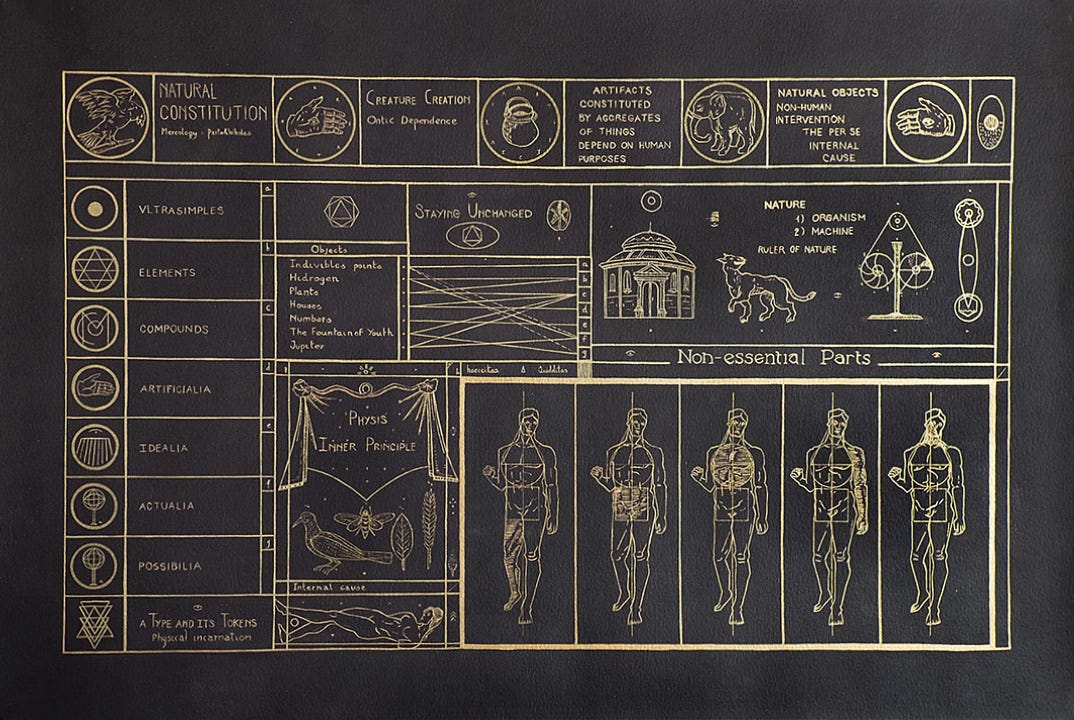
Image credits: Leon Ka (aka ‘Kafre’). Categories. Metallic ink, acrylic on 140 lb acid free paper, 17" x 25.25". Source: Anno Domini Gallery.
Kafre unites in his corpus two toposes which have been separated for far too long: analytical philosophy and graffiti. At night, Kafre dons his batman mask as a doctoral candidate and studies mereology, the theory of parts and wholes. During the day, he roams the streets of Barcelona, adorning its walls. Perhaps his work ‘Categories’ has no layers: it is all surface, a topographic map, if you will, of the ‘I’ that sees and not what its eyes see. You can feast on more of his works at his tumblr account.

We hope you enjoyed reading this issue of Crow & Colophon. Subscribe for free to receive updates about The Bombay Literary Magazine and notes of a literary persuasion. For information about how to send your work to The Bombay Literary Magazine, please visit our submit page.