
Waxing and Waning
How a Line Changes its Mind
Crow News:
Over the course of this week, we’ll be sending out notifications to the writers who offered their work for consideration in Issue 64. Thank you one and all for entrusting your work to us.
When one’s work is turned down, sometimes it can be hard to avoid feeling dejected or discouraged. Even the language we’re forced to use (‘submissions’, ‘acceptances’, ‘rejections’) is evocative of war and aggression, not that of requirement, appreciation and matching. Friend, we’ve been there. Find a hug, celebrate with ice-cream, jiggy-wiggy across the bathroom floor, and know you did good. And oh yes, consider sending us something else in due course.
Note: If you have’t heard from us by August 1, check the spam folder and then contact us at help@bombaylitmag.com.
Fortnightly Freudenfreude:
We have a couple of items to crow about:
(1) Jayasree Kalathil, TBLM’s managing editor for Poetry Translations, has been awarded this year’s New India Foundation Translation Fellowship to translate Adimamakka (children of the enslaved), the autobiography of Adivasi land rights activist C.K. Janu.
(2) Pervin Saket, our Editor-at-Large, has been selected as a 2026-27 Reading Fellow of McCormack Writing Centre (formally Tin House). In officialese: “This year-long engagement involves helping shape MWC’s programs, and will culminate in a writing residency in Portland, Oregon.” In other words, they’ll pay her to read new work, and later, polka in Portland.
Congratulations, Pervin! Congratulations, Jayasree!
For this post’s colophon, Pervin Saket has selected a poem from Satya Dash’s suite in Issue 63. We’ve added a second one too, to offer you a range of his voice. These gifts are accompanied by a third: Pervin’s reading of Satya Dash’s work, following the poem through how the lines turn, how they surprise or settle. It would be a compliment to Satya Dash if you agreed, and a compliment to the poems if you didn’t. A poet seeks to be read, which is the editor’s task to enable, but poems long to be remade, made your own. That freedom is yours to enjoy.
Pervin Saket | Waxing and Waning
How a Line Changes Its Mind
Perhaps the only unfortunate side-effect of reading poetry extensively is that surprise becomes increasingly rare. Editors and poets are all too familiar with how the mind rushes ahead of the line, and then finds itself disappointed on encountering the expected — yet again. Imagine a version of:
I thought of my boo every night and day
The month of June and the month of _
You know the word, even if the chronology is wrong, in fact, you don’t need the poet to supply it at all. Of course, good contemporary poetry has far less simplistic patterns, but even free verse metaphors and idioms fall on a predictability scale. Hence the delight of a truly unexpected line or a fresh enjambment. Hence the delight of Satya Dash’s ‘Lunar Eclipse’. The poem, for me, was a way to loosen my grip on what I thought I knew, if only for the space of a line at a time. A way to push my mind towards not just recognising, but revising.
The poem describes an evening between two people who appear to be learning how to inhabit the same space. One dozes on a beanbag printed with a giant moon while the other cooks Maggi. They eat from the same plate, watch television, wander outside and eventually lie beneath a blood moon until they ‘pass out with the stars’. From this summary, the poem seems to be anything but dramatic. The treatment however, is another matter. Consider the line breaks at the very beginning of ‘Lunar Eclipse’:
On the surface of the bean
bag, the image of a giantmoon, not so giant as its
real size but giant enoughto create a crater in the living
room when a torso indented it.In it, you sink down sleeping,
feet up. Hands down, it’s the bestthing I have never done.
Each line withholds the completion of a seemingly ordinary gesture. It gives us enough rope to invent our own closure, and then, turns it around. The first line ends with the image of the bean (the moon as a bean? I’m thinking), but then that pivots to ‘bean bag’. Next ‘the image of a giant’, which in my head is something out of Jack-and-the-beanstalk (maybe because of the bean association of the first line), but that morphs into a ‘giant moon’. And just when I’ve absorbed the idea of a crater in the living (which sounds heartbreaking), I need to revise it to the far less emotional ‘living room’. And I haven’t even come to the reversal of ‘sleeping / feet up./ Hands down…’.
These frequent turns could get frustrating if the only goal was cleverness or surprise. However, this structure is far more meaningful; I read the poem as navigating the vulnerabilities of a relationship, perhaps a new one. The fragments suggest the fear of revealing too much too soon, the enjambments embody how one might alternately withhold and reveal as a way towards intimacy.
For instance, the speaker confesses that eating from the same plate ‘takes from me / a great deal of will’ and ‘I am working / on sharing.’ Later, we’re told, ‘I don’t want to disappoint / myself.’ Structurally, as the speaker gives up old habits, there is almost a parallel movement, of the reader revising her old associations too. Every enjambment asks us to relinquish an interpretation in which we were already certain, to open ourselves to a fuller meaning that lies beyond the line. The poem is training us, like it is training the speaker, to change.
Colophon: Two Poems
SATYA DASH
Lunar Eclipse
On the surface of the bean
bag, the image of a giant
moon, not so giant as its
real size but giant enough
to create a crater in the living
room when a torso indented it.
In it, you sink down sleeping,
feet up. Hands down, it’s the best
thing I have never done. I put
a blanket over you. You snore
louder. I collect water in a bowl
to make Maggi. You wake up
to my slurping. The act of sharing
my plate with you takes from me
a great deal of will. I do it
because I am working
on sharing. I don’t want to disappoint
myself. Especially later. And you, now.
We discard the spoons, forking
our fingers. We chew till a couple
of Schitt’s Creek episodes
are done. Heading out
for a walk, we collapse
on the grass. Blabbering
to the blood moon, we
pass out with the stars.
Restlessness of the Pristine Ocean
My grandmother’s motivations while jumping off
a running train are not clear to me. No one narrates the story with any
real conviction. My father says, she probably fell
asleep and when the train was leaving, she realized it was her station. She must
have forgotten some luggage at the tea counter on the platform, says my aunt,
chuckling. My mother believes—you never know, she could have done it
for the adrenaline rush; she loved pulling stunts, which is why she made it
a facet of the myth grandma’s personality has become for me. I enjoy
listening to these glinty refractions, the way the singular truth of a body is juiced
into thick light in our mouths when we talk about what, when and how someone
did what they had to. At a lake-view bar in Bangalore, weeks before his wedding,
my friend bashfully confides he finds everything in life meaningless these days.
As we get smashed, in a spur of unsolicited inspiration I offer him the example
of MS Dhoni smacking the ball into orbit to finish a cricket match
and then suddenly lose my train of thought. He buys me another Long Island
iced tea. Later I text him— the game means so much that Dhoni has trained
himself to pretend it doesn’t matter, which is why he aces it— the meaninglessness
of a moment dancing beside its meaning, no? The next day my friend comes
to pick me up wearing a t-shirt bearing an image of Schrodinger’s cat inside
an opened box. My turn to buy him a drink. But my own doubts don’t let me tell him
the trained mind commits spectacular transgressions too. While interviewing
for a job when asked to talk about an adversity I converted
into an opportunity, out of nowhere I mention my unprocessed shame
from the decades of unhappiness my parents endure in living with one another
and how I try channeling that agony into working hard. This answer
makes sure it is the last question, the ropes of sweat
on the interviewer’s brow twisting my stomach into knotty growls
and I’m cordially shown the door. At a check up after an ECG, the physician says
my heart is fine but asks me to abstain from smoking. I start having dreams about
a benign boulder released from its chains in the left ventricle of my heart,
rolling down mossy hills, my father standing in its way as he throws a ball
for me to catch, my reaching across to save him, mother’s face growing younger
as she sprints from a meadow screaming my name. At my next job
interview, the sun soaks in the silver ocean
of the recruiter’s Zoom background and I find myself talking
about ambivalence.
→ More at: ‘Slippery Town’ & Other Poems', TBLM Poetry | Issue 63.
—
SATYA DASH is a recipient of the Vijay Nambisan Poetry Fellowship and the Srinivas Rayaprol Poetry Prize. He has also been a finalist for Platypus Press’s Broken River Prize. His poems appear in Beloit Poetry Journal, Ninth Letter, Poetry Wales, Prairie Schooner, and Cincinnati Review, among others. Apart from having a degree in electronics from BITS Pilani-Goa, he has been a cricket commentator. He has been nominated previously for Pushcarts, Nina Riggs Poetry Award, Orison Anthology and Best New Poets. He grew up in Cuttack and now lives in Bangalore, India. [Text source: Satya Dash]
ACKNOWLEDGEMENTS:
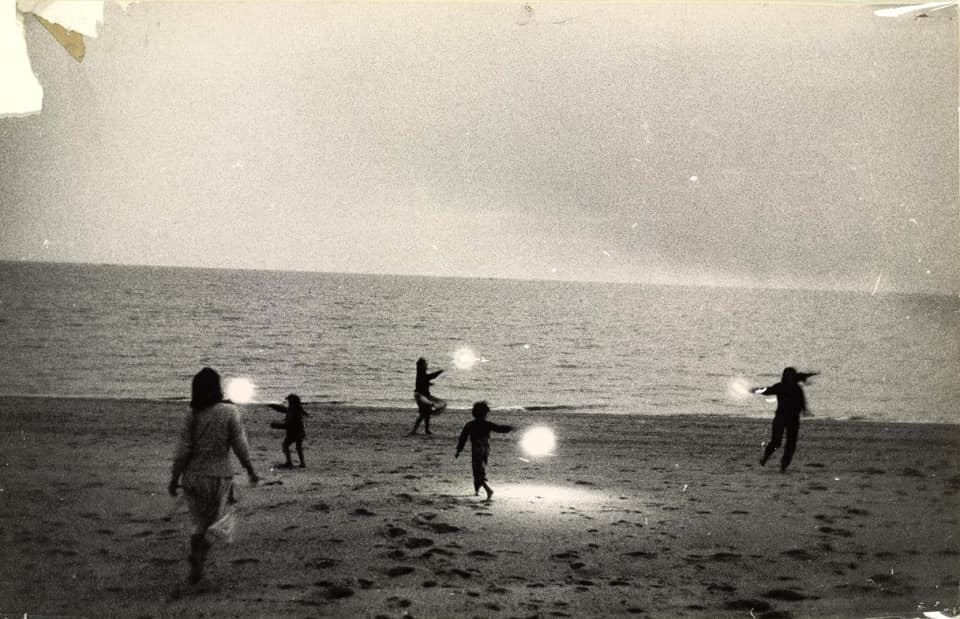
Image credits: Robert Frank (1924-2019). Children with sparklers in Provincetown (1958). Gelatin silver print, 21.3 x 31.8 cm. Most B&W photographs can evoke memories, but it’s only a rare few that can actually look like memories. This is one such. We felt it matched the meditative, yet conversational mood in Satya Dash’s set of poems, which hold up old memories to sparkle in the light of the reader’s consciousness.

We hope you enjoyed reading this issue of Crow & Colophon. Subscribe for free to receive updates about The Bombay Literary Magazine and notes of a literary persuasion. For information about how to send your work to The Bombay Literary Magazine, please visit our submit page.