
You are That
Notes on Second Person
Crow News:
Words, words, words. Words to the left of us. Words to the right. Words from porch to horizon. The grass is sleeping, the wind is cycling, and the editors are reading. Somewhere, off in the distance, a dog barks.
Fortnightly Freudenfreude:
Sukhada Tatke, TBLM’s Managing Editor (Essays), has been awarded the Scottish Book Trust’s Kavya Prize for narrative nonfiction. This is part of the Trust’s annual New Writers Award Programme. Congrats, Sukhada! Double the rations!
Also, Maithreyi Karnoor’s collection of short fiction, Gooday Nagar (Tranquebar, Westland Books), is now available for purchase. We’d published one of the stories in the collection—’Ringa Ringa Roses’— in Issue 51. Congrats, Maithreyi! We recommend celebrating with jackfruit ice-cream.

For this fortnight’s colophon, our Editor-at-Large Pervin Saket has selected the poem ‘(U)’ from Khushi Bajaj’s suite of poems which appeared in our current issue (#62). Readers of a soteriological bent will probably recognise Pervin’s title ‘You are That’ as a nod to Nisargadatta Maharaj’s Advaita classic I am That. Readers of a non-soteriological bent will be relieved to learn the last bit of datum can be filed in the recycle binum. The focus of the note is ‘you’, crooked little timber and all.
Pervin Saket | You Are That
Notes on Second Person
Last month I found myself rereading Atwood’s The Handmaid’s Tale, and was surprised at how I noticed passages that hadn’t really registered earlier. Perhaps because the world of the story feels far less speculative these days, my gaze stayed with the perspective instead. The first time the Commander asks Offred to kiss him, she is shaken and anxious: ‘What I need is perspective… Otherwise there are only two dimensions. Otherwise you live with your face squashed against a wall, everything a huge foreground of details, close-ups, hairs, the weave of the bedsheet, the molecules of the face… Otherwise you live in the moment. Which is not where 1 want to be.’ I was struck by how in the very paragraph about needing perspective, the Offred divides the self into two pronouns: you and I.
Something of this perspective stood out sharply on reading Khushi Bajaj’s poem ‘(U)’. The poem, narrated entirely in second person, begins dramatically with a twenty-fifth birthday celebration interrupted by a health crisis. The speaker is rushed to the emergency room, after which we see an endless choreography of hospital visits, where the person is reduced to a patient. While the mother feebly attempts some semblance of a celebration between doctors’ visits, the speaker attempts to cope through humour. And, more interestingly for me, through dissociation.
I am usually wary about second person narratives, because too often the ‘you’ is a veiled ‘I’ that is trying not to sound self-indulgent. However, in Khushi Bajaj’s poem, the second person suggests a split consciousness. The narrating self seems to be deliberately separated from the experiencing self. I read this as a form of distancing from trauma, as if it is happening to someone else. As if that separation is necessary for the speaker to make sense of an uncertain future. As if it carries a subtext of attempted comfort in the face of turbulence. You’re fine, you’ll get through this. Breathe.
I’m thinking of Claudia Rankine’s ‘Stop-and-Frisk’, an account of racial profiling, which is narrated from a split point of view as a form of dissociation. Or of Reginald Shepherd’s ‘You, Therefore’ which merges and separates two lovers through a dreamlike sequence of loss and alienation.
This perspective would have been enough to carry the poem through. But I was moved by how Khushi Bajaj has another layer to offer. She splits the second person further into ‘you’ and ‘u’. The abbreviated ‘u’, which appears towards the end (and in the title), is interesting because it is framed as a symbol within an equation. The person becomes a problem to be solved. A data point. While I had been curious about the mathematical symbols woven through the poem, this turn hit hard. It is where the language mirrors how the self has been reduced to a variable.
All of this, when seen within the context of the ‘brown, queer body’ that the speaker describes, also shifts the texture of the pronoun. It makes the pronoun intimate. The second person is not just a distancing device from the self, but a gesture towards the other. It draws the reader into its own pain and confusion. It is a reaching out, a call for empathy. A way of saying: My pronoun is you.

Colophon: (U)
KHUSHI BAJAJ
First Published: Searching & Other Poems. TBLM | Poetry, Issue 62 (Dec 2025)
your gorgeous yellow crop top and black low-high skirt are laid out on your bed. you saved for two months to afford this outfit. you are laid out on the floor.
you are about to spend your 25th birthday getting a blood transfusion.
a dizziness will make its way from your head to body before you will make your way out of this bedroom.
when the emergency room nurse will put an IV in your arm, your mom will be sitting on the bed pretending to not freak out. your gen-z humour will have made you put on a nadja t-shirt before leaving the house. you will wink at her, encouraging her to (+) the images and participate in your vampire-themed birthday party.
you remember entering your kitchen last year in the middle of a suicidal ideation episode and seeing your flatmate. she said that she was seeing you smile after a long time. you had just finished a session with your therapist who had laughed at every single sentence that left your mouth. in other ways you cannot function when you are having a breakdown, but when you are at your lowest, your punchlines (*) like it is showtime at the apollo.
your mom will offer to buy the hospital staff samosas. this will be an attempt to make your day celebratory. but the canteen cook will not be working till later. your family will tell you a story about how surviving is the best way to spend your 25th. you are having a (¼) life health crisis and are tired of surviving it.
newly out of resilience, your brain will now stop running a (x:y::a:b) before welcoming an anxiety attack. you will visit so many hospital rooms in the next month that you will start wanting to (-) the white walls from your memory before you even enter them.
your mom will want to treat you to fancy lunches on your drives home but you will say no each time, convinced that the only thing that will nourish you is your own bed. when this started you thought you had a medical issue but they will soon turn your brown, queer body into a math problem:
if your period lasts for more than 43 days and they can give you one unit of blood or iron a week, then why the fuck are doctors still refusing to give (u) a diagnosis? (show your work)
--
KHUSHI BAJAJ (she/her) is a multilingual poet and writer from Lucknow, India who currently lives and creates in London. Her work has previously been published by Penguin Random House, fourteen poems, Feminism in India, Film Companion, Gaysi Family, and more. She has won the international Briefly Write Poetry Prize, and been highly commended for the Disabled Poets Prize and the erbacce-prize. She is passionate about intersectional feminist politics, supporting local communities, and radical kindness. [Text source: Khushi Bajaj]
ACKNOWLEDGEMENTS:
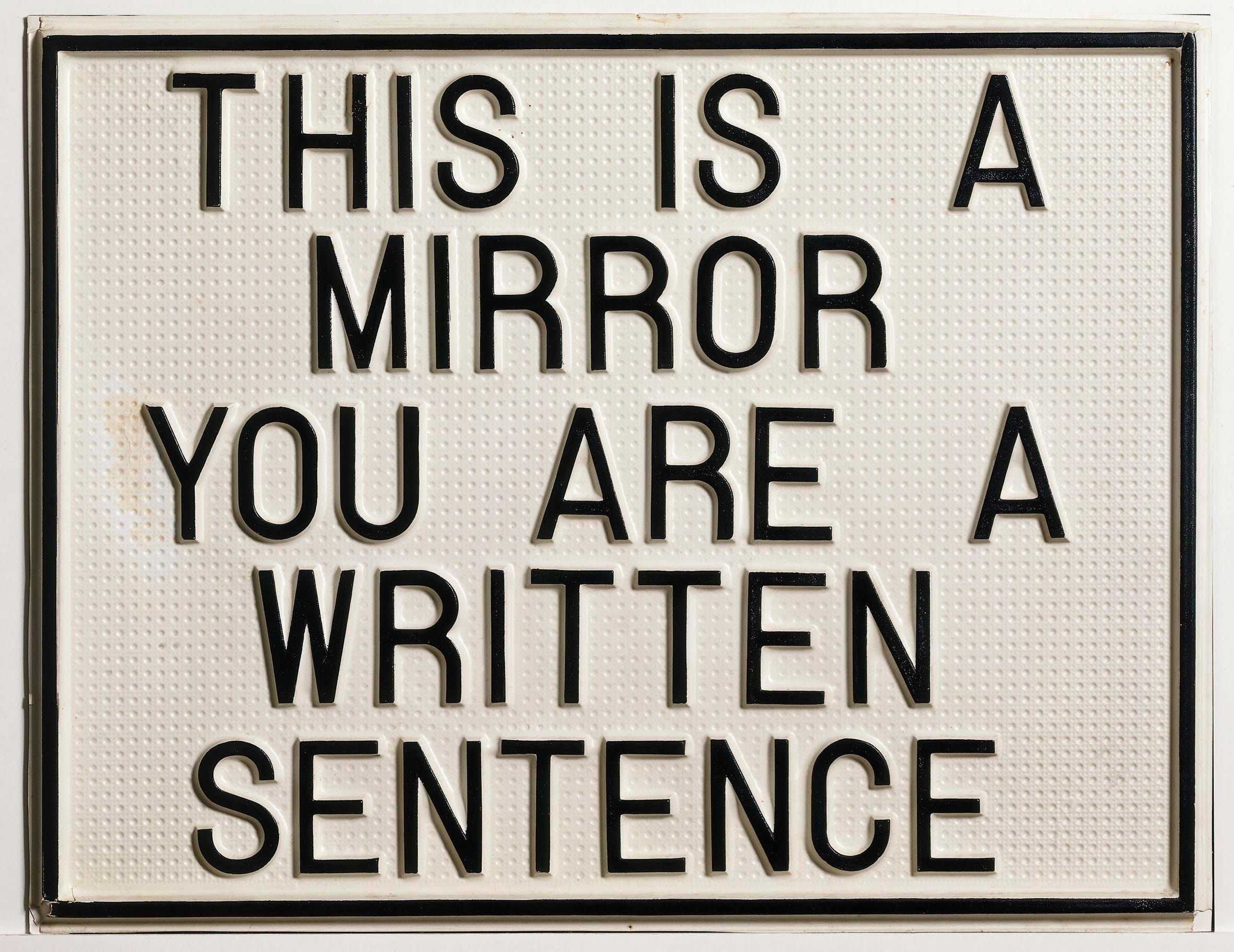
Banner image: © Luis Camnitzer (1937—). This is a Mirror, You are a Written Sentence (1968). Image courtesy: Wikiart. Reproduced under Fair Use terms.
This is Camnitzer’s first work in conceptual art. He was a trained, very skilled artist noted for his expressionist works, until he grew tired of alluding to what he wanted to say. Why not just say what he wanted to say? What’s with all the fancy colouring between the lines and eyes in all the wrong places? For example, do you detest the wreckage inflicted by colonialism? All right. Jam three carving knives into a gallery wall and call ‘em ‘Nina’, ‘Pinta’ and ‘Santa Maria’. Done! Camnitzer’s paintings aren’t hard to understand. This accessibility may explain his relative neglect by the art establishment, but Holland Cotter for the New York Times reports that people once again seem to have developed an inexplicable fondness for art that makes sense.

We hope you enjoyed reading this issue of Crow & Colophon. Subscribe for free to receive updates about The Bombay Literary Magazine and notes of a literary persuasion. For information about how to send your work to The Bombay Literary Magazine, please visit our submit page.
Love you people from BLM and thank you so much, for bringing such literary gems to light, via your magazine!!! 💜🙌🙌